
Quick Answer
-
The main early signs are a cough that won’t clear, breathlessness on activity, wheezing, and chest infections that keep coming back
-
Most people put these down to a “smoker’s cough”, ageing, or low fitness, so COPD is often found years late
-
Even mild (stage 1) Chronic obstructive pulmonary disease (COPD) can cause symptoms, although some people notice very little at first
-
Smoke from cooking fuel, dust, fumes, and polluted air raise the risk too, not just cigarettes
-
A simple breathing test called spirometry confirms it, so symptoms lasting more than a few weeks deserve a check
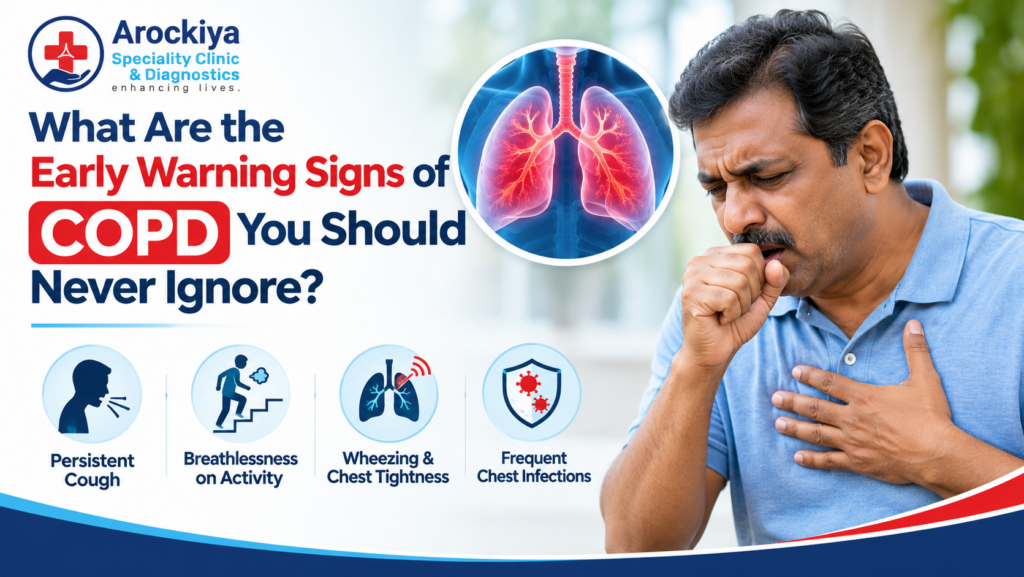
The early warning signs of COPD are easy to miss because they creep in slowly: a cough that lingers after every cold, getting breathless on stairs you used to climb easily, a wheeze at night, or chest infections that keep returning. Many people blame age, smoking, or poor fitness, which is why COPD is often found only after years of lung damage. Experts at this month’s GOLD conference estimated that about 70% of people with COPD worldwide are undiagnosed. If any of these first signs of COPD sound familiar and have lasted more than a few weeks, it’s worth getting your lungs checked.
What Is COPD, and Why Are Its Early Signs So Easy to Miss?
COPD, or chronic obstructive pulmonary disease, is a long-term lung condition in which the airways narrow and lung tissue is damaged, so air moves in and out less easily. Chronic bronchitis and emphysema are the two forms most people have heard of, and many people have a mix of both.
The trouble is that it starts quietly. In a community study of adults over 40 in Sonipat, Haryana, published in the International Journal of Chronic Obstructive Pulmonary Disease in 2025 (https://www.dovepress.com/sub-optimal-chronic-obstructive-pulmonary-disease-copd-management-in-i-peer-reviewed-fulltext-article-COPD), only about 5% of people whose breathing tests showed mild COPD knew they had it.
Early Warning Signs of COPD to Watch For
The NHS lists four main symptoms: breathlessness (especially when active), a persistent chesty cough with phlegm, frequent chest infections, and persistent wheezing. Here’s what each looks like day to day.
COPD Cough Symptoms
A cough that keeps going for weeks, often with mucus, and is usually worst in the morning. This is the classic picture of chronic bronchitis symptoms, and it’s the one most often waved off as a “smoker’s cough”. GOLD notes that some people develop real airflow obstruction without much cough at all, so a quiet chest doesn’t rule COPD out.
COPD Shortness of Breath
This usually shows up with effort first: stairs, a slope, carrying shopping. Many people slow down or avoid these activities without realising why. Some wake at night feeling breathless. Breathlessness is also the main thing to look for among the signs of emphysema and COPD, where damaged air sacs make it harder to move air. If it’s slowly getting worse, don’t simply put it down to age.
Wheezing and Chest Tightness
A whistling sound when you breathe out, or a tight feeling in the chest, especially on waking or in cold, smoky, or dusty air.
Frequent Chest Infections
Colds that settle in the chest, take longer than they used to, or return several times a season. GOLD lists recurring lower respiratory infections as a reason to consider COPD.
COPD Fatigue Symptoms
Feeling unusually tired or getting less done, because breathing takes more effort. It’s a less specific sign, but together with a cough or breathlessness it adds to the picture.
COPD Symptoms Stage 1: Can Mild COPD Cause Symptoms?
Doctors grade COPD from stage 1 (mild) to stage 4 (very severe) based on how much airflow is reduced on a breathing test. At stage 1, some people feel little more than an occasional cough or breathlessness on exertion.
But “mild” can mislead. GOLD’s newest report, released around World COPD Day this month, stresses that the word describes the test result only, not how much the disease affects you. Many people with mild airflow obstruction have symptoms and flare-ups. So mild COPD symptoms deserve attention, and having no symptoms doesn’t mean your lungs are fine if you’re at risk.
Who Should Watch for COPD Early Signs and Symptoms?
- Current or former smokers, especially anyone over 35. Smoking remains the most important risk factor for COPD, and the NHS advises anyone over 35 who smokes or used to smoke to see a doctor about persistent symptoms. Quitting doesn’t erase that history, which is why former smokers are included. Many smokers also delay getting checked because they expect to be told to quit, which is one reason the disease is found so late.
- People who live or work around others who smoke are at risk. Secondhand smoke is easy to overlook, yet in the Sonipat community study COPD was more common among people exposed to environmental tobacco smoke. If you share a home, car, or office with a smoker, you can be at risk even though you’ve never smoked yourself. Mention to your doctor if a cough or breathlessness has crept in.
- People who have cooked on wood, charcoal, or other biomass fuel. A review of Indian studies found COPD in about 10% of people exposed to biomass fuel smoke, compared with about 3% of non-smokers overall. Another Indian study of women exposed to biomass fuel found that the risk rose with the number of years of exposure and with starting at a younger age. This group is often missed, because spirometry isn’t widely available and the hazards of cooking smoke aren’t widely known.
- People who are exposed to dust, fumes, or chemicals at work are at risk. Occupational exposure sits alongside smoking and biomass fuel in GOLD’s list of risk factors. Years in construction, factories, workshops, or other dusty or smoky settings can add to the damage quietly. Never-smokers make up roughly a fifth to a half of COPD cases in published studies, so a clean smoking history shouldn’t make you dismiss the early signs of COPD, such as a lingering cough.
- People who spend years in heavily polluted air, such as daily commuters on busy roads like OMR. Air pollution is listed among the risk factors for COPD in non-smokers, and Indian doctors increasingly see the disease in people who have never touched a cigarette. The effect is harder to measure than smoking, so it’s easier to brush off. If you commute daily in heavy traffic and a cough continues to return, or you get breathless more easily than before, a lung check is reasonable.
- People who have a history of tuberculosis or repeated pneumonia are at higher risk. In the Sonipat study, COPD was more common among people with a past history of TB treatment or pneumonia. TB can cause permanent harm in the lungs, and a review of studies found a link between past pulmonary TB and long-term airflow obstruction. If you’ve had either illness, don’t assume your lungs recovered fully just because the infection was treated, and ask for a breathing test if a cough or breathlessness lingers afterwards.
- People who have had long-standing asthma or frequent chest infections since childhood are at risk. GOLD’s description of people at risk includes a history of early-life respiratory events, and doctors list poorly controlled asthma among the risk factors for COPD. Not everyone with asthma develops COPD, but if your breathlessness or wheeze has changed or no longer responds the way it used to, it’s worth asking whether something more is going on. The two conditions can be difficult to tell apart without a breathing test.
- Older adults. COPD is more common in people over 50 than in those aged 40 to 49, according to the Sonipat study. COPD symptoms in older adults are the ones most often blamed on age, which helps explain why the average age at diagnosis worldwide is 65 to 70, long after the damage began. Don’t accept breathlessness as normal aging; ask for a breathing test and encourage your parents or grandparents to do the same.
You don’t have to smoke to be at risk, and early signs of COPD can appear in people who have never smoked. A review of Indian studies found COPD in about 3% of non-smokers overall, but around 10% of those exposed to biomass fuel smoke.
When Early Signs Suddenly Worsen: COPD Exacerbation Symptoms
Sometimes symptoms flare up over a few days: more breathlessness, more coughing, or a change in the amount or colour of phlegm, sometimes with fever. These COPD exacerbation symptoms mean you need to be seen promptly. Go to an emergency department right away for severe breathlessness, trouble speaking, blue or grey lips, confusion, or chest pain.
When Should You See a Doctor?
Any of the early warning signs of COPD below, lasting more than a few weeks, is a reason to book a visit:
- A cough or phlegm lasting more than a few weeks
- Breathlessness doing things you used to manage easily
- Wheezing or chest tightness that keeps coming back
- Chest infections that recur or take long to clear
- Any of these, along with smoking, past smoking, or long exposure to smoke or dust
Breathlessness can also come from the heart, so it’s worth knowing the symptoms of heart problems too. To sort out the cause, a pulmonologist in Navalur can arrange spirometry, which measures how much air you can blow out and how fast, and a chest X-ray to rule out other problems. GOLD says spirometry is needed to confirm COPD, because symptoms alone can’t.
What to Do Once You Notice the Signs
- Keep a short symptom diary: when you cough or get breathless, and what sets it off
- Cut your exposure to smoke where you can, including cooking smoke and dust
- Don’t wait for a winter flare-up to get checked
- Mention every symptom, even ones that seem small, such as tiredness on stairs
Summary
The early warning signs of COPD rarely feel urgent: a cough that never quite clears, a little more breathlessness on stairs, a chest that catches every cold. Because they build slowly, they’re easy to dismiss, even though finding COPD early gives you far more room to protect your lungs.
If any of this sounds familiar, don’t wait for a flare-up. Book an appointment with Arockiya Speciality Clinic & Diagnostics in Navalur, Chennai, and get a proper lung check.
Frequently Asked Questions
Most people first notice a cough that won't go away, often with mucus, or breathlessness during activity such as climbing stairs. Wheezing and frequent chest infections are also common early on.
Yes. GOLD notes that significant airflow obstruction can develop without much cough, so breathlessness, wheezing, or repeated chest infections still count as warning signs.
The symptoms are the same: cough, breathlessness, and wheeze. What differs is the cause, such as years of cooking smoke, dust, fumes, or polluted air, which people often don't link to their lungs.
No. Breathlessness can also come from asthma, heart problems, anaemia, or low fitness. That's why a doctor should check it, rather than guessing the cause.
They're largely the same, but older adults and their families often put them down to ageing. The early signs of COPD, such as breathlessness that is getting worse or a cough that never clears, are worth testing at any age.
Over a few days, breathlessness and cough get worse, and the phlegm may increase or change colour, sometimes with fever. This needs prompt medical attention, and severe breathlessness is an emergency.
With spirometry, a breathing test measuring how much air you can blow out and how quickly. A chest X-ray is often done as well, to look for other causes of your symptoms.
Arockiya Speciality Clinic & Diagnostics in Navalur, Chennai offers pulmonology consultations along with spirometry, lung function tests, and chest X-rays. You can book an appointment directly through the clinic.