
Quick Answer
Back pain isn’t only an aging problem anymore; it’s common among IT professionals in their 20s and 30s
In a Chennai study of software professionals, age made no statistically significant difference to who reported musculoskeletal symptoms
Symptoms were linked to long hours, few breaks, and exercise habits you can change early.
Seeing a doctor early for repeated back pain is prevention, not overreaction
Most early back pain improves with movement, a better setup, and physiotherapy
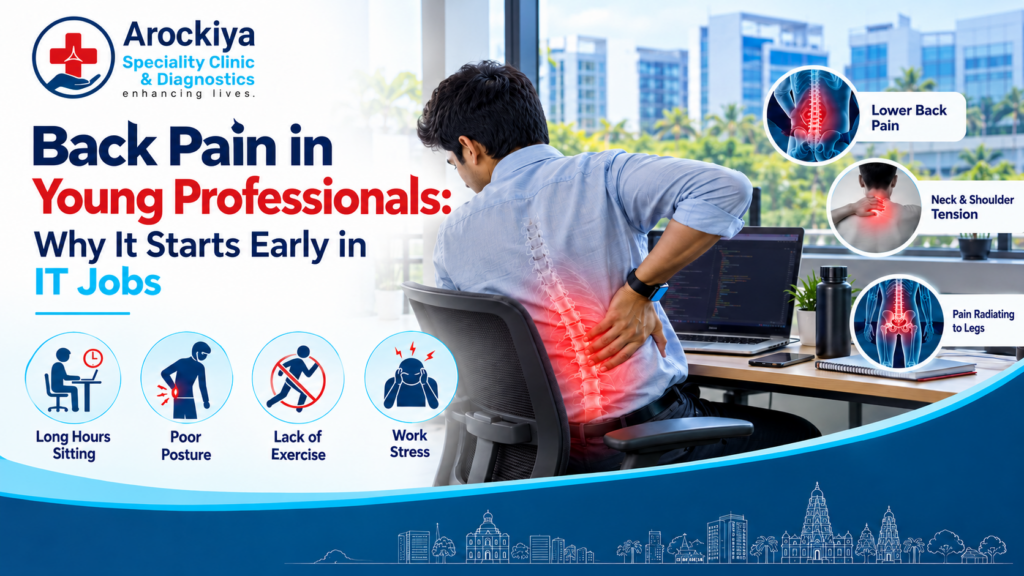
Back Pain in Young Professionals: Why It Starts Early in IT Jobs
QUICK ANSWER
• Back pain isn’t only an aging problem anymore; it’s common among IT professionals in their 20s and 30s
• Symptoms were linked to long hours, few breaks, and exercise habits you can change early.
• Seeing a doctor early for repeated back pain is prevention, not overreaction
• Most early back pain improves with movement, a better setup, and physiotherapy
If you’re in your late twenties and your lower half is already bothering you by evening, Back pain in young professionals is no longer unusual, and IT jobs along the OMR corridor make the pattern easy to see. A study of software professionals in Chennai found that 69% had a work-related musculoskeletal complaint in the past year, and age made no significant difference to who reported one. The usual culprits aren’t about age; they’re long days, few breaks, and little exercise. Those are habits, and habits are easiest to change early, before back pain in your 20s becomes a long-term problem.
Is Back Pain in Young Professionals Really That Common?
Yes, and the numbers are difficult to ignore. In a 2015 study of software professionals in Chennai, published in the International Journal of Community Medicine and Public Health, about 23% reported lower back trouble over the past year, second only to neck complaints. Age, BMI, and years in the job made no statistically significant difference to who had symptoms, which suggests that being new to the job didn’t protect anyone.
A 2025 analysis in Cureus looked at records of nearly 17,000 low back pain patients at private centers across 18 Indian states. Adults aged 18 to 38 constituted the largest share, about 43%, ahead of the 39 to 59 group. That reflects who comes in for care, not everyone with back pain, but it points the same way. The authors noted that among young adults of normal weight, activity levels, ergonomics, and stress probably matter more than body weight.
Why Back Pain Starts Early in IT Jobs
Long Hours and Few Breaks
In the Chennai study, symptoms differed significantly with working more than eight hours a day, working more than five days a week, and taking fewer regular breaks. All of that is usual in IT. Lower back pain from sitting builds quietly: slightly worse each afternoon, easy to blame on a long day, until it stops going away.
Little Regular Exercise
Exercise habits also differed significantly in that study. A desk day, a long commute, and exhausted evenings leave little room for the walking, sport, or strength work that supports the back. A normal weight does not compensate for it.
Chair Setup and Screen Height
No single “perfect” sitting position has been proven, but a poor setup makes things harder. A screen that’s too low or far pulls you into a slump, and a chair without lower back support leaves it working overtime. A sensible ergonomic chair setup with feet flat, hips and knees roughly level, and lower back supported and a screen near eye level makes it easier to sit comfortably and change position. However, it is important to note that no chair can substitute for the benefits of movement.
Stress and Monotony
In a study of 1,355 Indian adults aged 18 to 35, mostly competitive-exam aspirants, published in the Asian Spine Journal, stress, monotonous routines, and long daily sitting hours were linked to low back pain. Deadline pressure and a same-screen routine will sound familiar to anyone in IT.
How Sitting, the OMR Commute, and Long Hours Add Up
Picture a typical day: a sit-down commute along OMR, eight or nine hours at a desk, the commute home, and then the sofa. Many people sit for most of their waking hours with barely a break. Research on commuting alone is mixed in the young-adult study above; travel time wasn’t independently linked to low back pain, so the commute isn’t the villain by itself. The problem is the unbroken total, and early-career pressure often squeezes out the exercise that would balance it.
Back Pain Signs Worth Taking Seriously
• Lower back stiffness or ache that returns most days after sitting
• Pain that eases over the weekend but is back by Tuesday
• An ache that has started to spread into the buttock or leg
• Needing to stand, shift, or stretch every few minutes to get comfortable
• Back pain that’s starting to affect your sleep, workouts, or concentration
None of these means something is seriously wrong. They indicate that a pattern has begun, and back pain in young professionals is much easier to address now than after months of enduring it.
When Should You See a Doctor?
Seeing a doctor early isn’t overreacting. Most back pain settles within a few weeks, but a past history of spine problems was one of the factors linked to low back pain in the young-adult study above, so repeat episodes are worth acting on. NHS guidance suggests getting medical advice if:
• Pain is getting worse despite home care or hasn’t eased after several weeks.
• Pain wakes you at night
• Back pain follows a fall or injury
• You have a fever or are losing weight without trying, alongside back pain
Go to an emergency department straight away if back pain comes with numbness around your genitals or buttocks, loss of bladder or bowel control, or weakness or numbness in both legs.
An Orthopedic consultation in Navalur can tell you whether it’s a simple muscle strain or something that needs closer attention, and physiotherapy for back pain is often the next step for early cases.
How Can Young Professionals Prevent Early Back Pain?
• Stand up and move for a minute or two every 30 to 45 minutes. Take a call on foot, refill your water, stretch
• Set your chair so your feet are flat and your lower back is supported, with your screen near eye level
• Change position through the day sit, stand, and walk rather than hunting for one perfect posture
• Build in regular exercise; you’ll actually keep up, and include work that strengthens your back, hips, and core
• Don’t wait out recurring episodes. The first few weeks of a pattern are the easiest time to fix
For a comprehensive overview of desk-job pain, from neck to lower back, refer to the complete desk-job pain, from neck to lower back, and read the full desk-job pain guide
Summary
Back pain in young professionals isn’t a quirk of aging. In Chennai’s IT workforce it shows up early, and the research points to habits of long hours, few breaks, little exercise, and a setup that doesn’t let you move rather than age. You can change all of them.
If your back has started to complain, don’t wait for it to get worse. Schedule a check-up at Arockiya Speciality Clinic & Diagnostics in Navalur, Chennai, before back pain becomes a regular part of your life.
Frequently Asked Questions
Long hours, infrequent breaks, limited exercise, and a stationary setup all contribute to the issue. In a Chennai study of software professionals, these work habits were linked to symptoms, while age and years in the job were not.
It's common, but it isn't something to simply accept. Occasional stiffness after a long day can be ordinary, but pain that keeps returning, spreads, or disturbs your sleep deserves a proper assessment.
Long, unbroken sitting is linked to lower back pain, and it's the lack of breaks and movement that matters most. Standing up briefly every 30 to 45 minutes helps more than trying to hold one perfect posture.
A good ergonomic chair setup helps you sit more comfortably, but it isn't a cure on its own. Moving regularly and staying active matter just as much.
Regular physical activity including work to strengthen the back, hips and core can help the body cope with long hours of sitting.Regular breaks and sensible desk arrangements work best with it.
Many episodes ease within a few weeks. If yours is getting worse, keeps coming back, or hasn't improved after several weeks, it's worth getting it checked rather than waiting.
Yes, if it keeps coming back. Repeated episodes are usually a sign that the habits or the setup need some attention . Checking early is far easier than treating a long - standing problem .
Arockiya Specialty Clinic & Diagnostics, Navalur, Chennai offers consultation with orthopedic surgeon and physiotherapy for back pain due to long hours of sitting at the desk. You can book an appointment directly through the clinic to get an assessment and a plan suited to your symptoms.